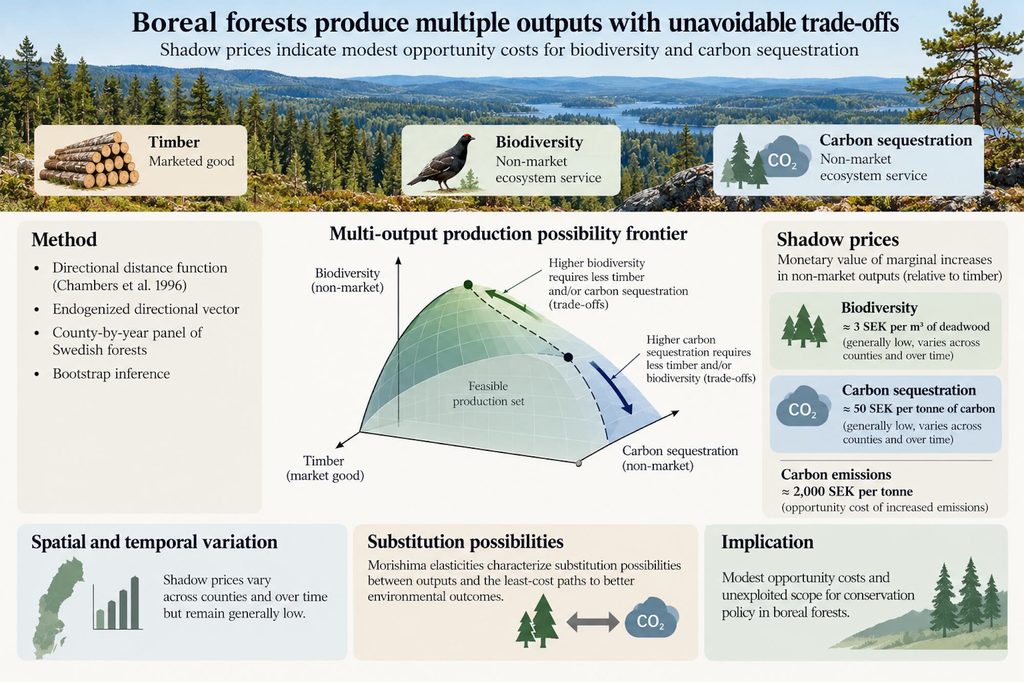
Boreal forests produce timber for the market, but they also provide ecosystem services that have no market price, such as biodiversity and carbon storage. Choosing more of one means giving up some of the other. In a new open-access article in Land Economics, CERE researchers Shuyi Wang, Moriah B. Bostian and Tommy Lundgren estimate how much those environmental benefits actually cost in terms of timber forgone.
The researchers estimate shadow prices (implicit prices for goods that are not bought and sold) using a directional distance function, applied to Swedish forest data by county and year. The prices vary across regions and over time but are generally low. In other words, improving biodiversity and carbon sequestration costs relatively little timber production. The study also maps how easily the different outputs can be substituted for one another, pointing to the least costly ways to better environmental outcomes.
The authors conclude that there is untapped room for conservation policy in boreal forests.
Read the article: Wang, S., Bostian, M. B. & Lundgren, T. (2026). Shadow pricing ecosystem services in boreal forests. Land Economics. https://doi.org/10.3368/le.103.2.101525-0088R1