
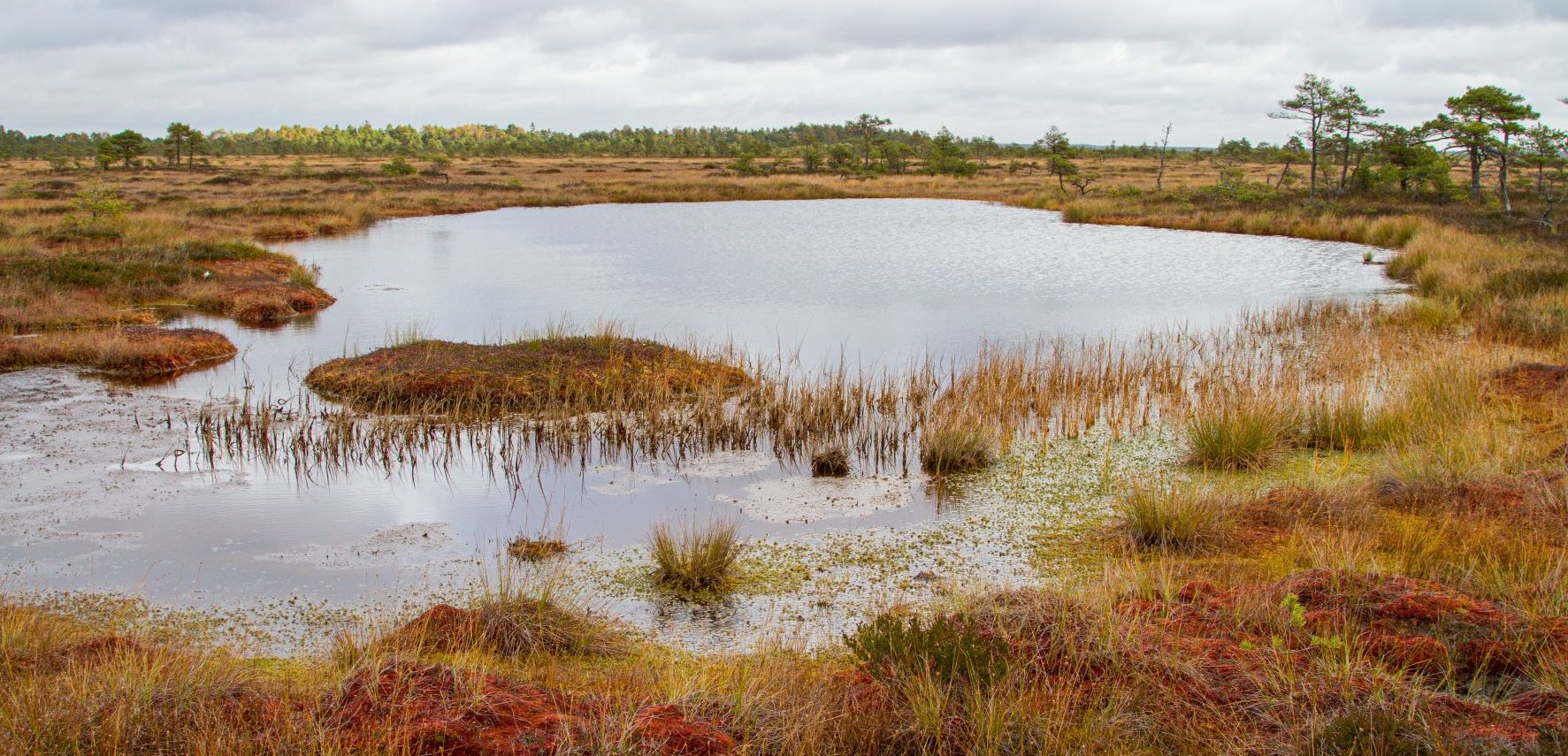
The EU’s new restoration law could become an important tool for aligning Swedish policy on peatlands. A new study by CERE researchers at the Swedish University of Agricultural Sciences (SLU) shows that current governance is fragmented and sometimes contradictory, making it difficult to achieve climate and conservation goals.
In the research study “A policy analysis of peatland-related policies – pressures, ecosystem services, conservation and restoration”, CERE researchers Chaitanya Suarez Rojas (SLU) and Camilla Widmark (SLU) examined a wide range of policy documents, strategies, and laws related to peatlands at global, European, and national levels. The analysis also includes documents connected to biodiversity, nature conservation, climate change, agriculture, forestry, energy, land use, and water management.
The results show that governance is often inconsistent. Some documents allow continued peat extraction for energy purposes, while others—particularly those within environmental protection and agriculture—classify peatlands as valuable habitats and emphasize the need for restoration. This creates uncertainty for decision-makers and practitioners.
The researchers recommend that Sweden use the new EU law as an opportunity to develop a coherent national strategy for peatlands, similar to those in Finland and Germany. Currently, Sweden is far from meeting its own targets: of the 100,000 hectares of peatland scheduled for restoration by 2040, only 3,600 hectares had been restored by 2024.
Such a strategy should coordinate existing guidelines, be based on nature-based solutions and ecosystem services, include sufficient resources and compensation for landowners, and ensure that responsibilities and mandates are clearly defined.
The study can be found here.